
Top 10 Things Bruce Clay Gave to SEO

Key Takeaways
- Bruce Clay helped shape SEO before Google became the main search engine.
- He gave the industry tools, training, ethics, language, and structure.
- His work made SEO easier to learn, explain, and practice.
- His biggest gift was not only knowledge, but a standard of trust.
- This tribute remembers Bruce Clay as a teacher, pioneer, and builder of SEO.
Bruce Clay was one of the earliest names in search engine optimization. After his passing, many people in the search industry remembered him as the “Father of SEO.”
That title was not just praise. It came from decades of work.
Bruce Clay started Bruce Clay Inc. in January 1996. This was before Google Search launched in 1998. At that time, SEO did not have clear rules, common language, or trusted training paths.
So Bruce helped build them.
He gave the world more than rankings. He gave SEO a shape. He gave it ethics. He gave it education. He gave it a language that many marketers still use today.
This is a story of the top 10 things Bruce Clay gave to the world in SEO.
1. He Helped Give SEO Its Name
In the early web years, people were trying to make pages appear in search engines. But the work did not have one clear name.
Some called it search engine placement. Some called it web promotion. Others used different terms.
Then Bruce Clay became one of the first people credited with using the term “search engine optimization.” That mattered a lot.
A name gives a field an identity.
Because of that, SEO became easier to teach. It became easier to sell as a service. It became easier for businesses to understand why search traffic mattered.
Before SEO was a career path, Bruce Clay helped make it sound like one.
2. He Built One of the First Real SEO Agencies
Bruce Clay founded Bruce Clay Inc. in 1996. At that time, the web was still young. Google had not yet become the center of search.
Still, Bruce saw that search engines would change business.
He started helping websites rank when most companies did not even understand search traffic. His company grew from an early consulting idea into a global search marketing firm.
This gave the SEO industry a serious business model.
It showed that SEO was not a small trick. It could be a professional service. It could support clients, teams, tools, training, and long-term strategy.
That was one of Bruce Clay’s biggest gifts: he helped SEO become a real industry.
3. He Created the Search Engine Relationship Chart
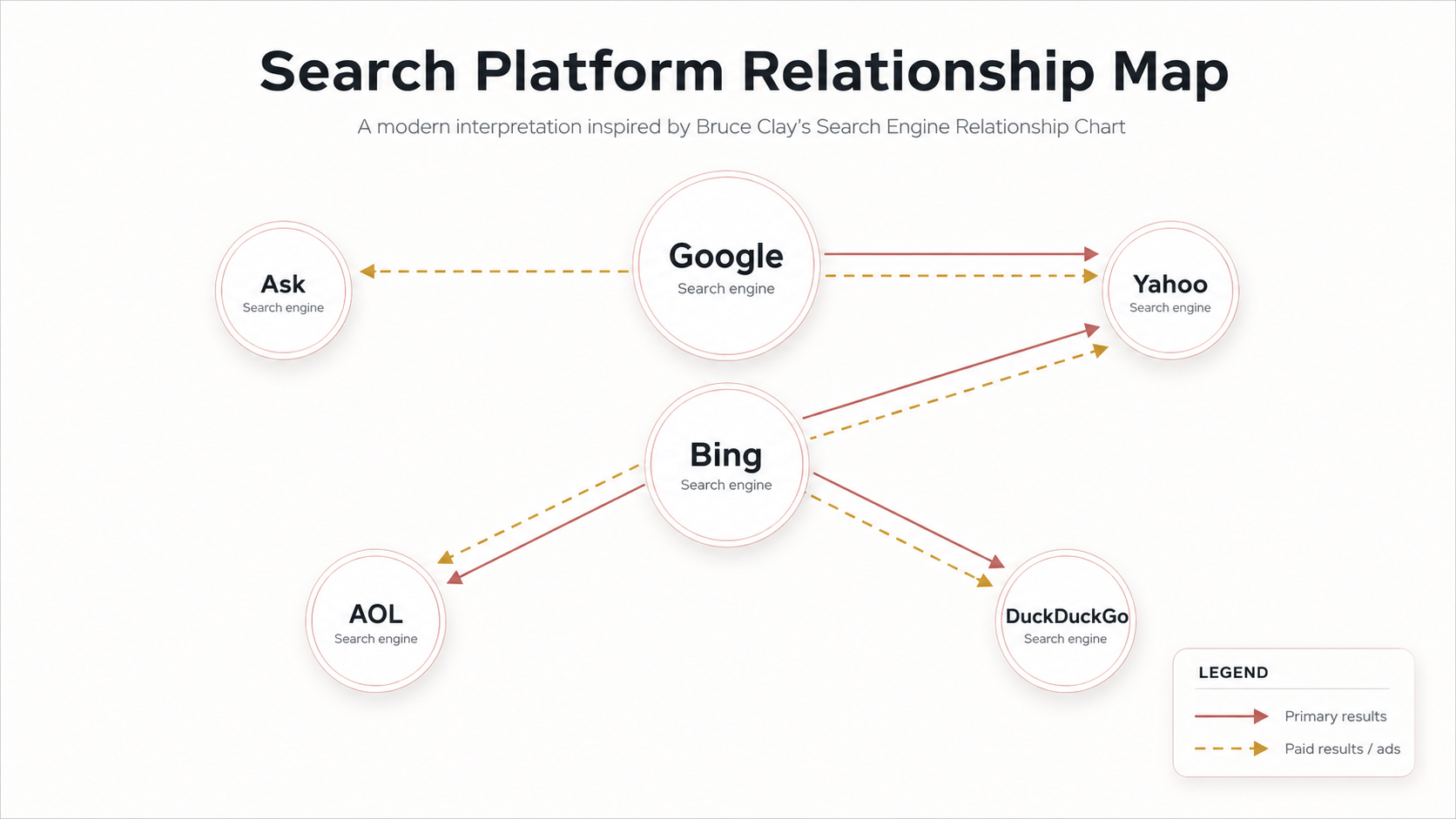
In the early 2000s, search was confusing.
Many search engines shared data with each other. Paid listings, crawler results, directories, and partnerships were all connected in messy ways.
Bruce Clay made that easier to understand.
In 2001, he created the Search Engine Relationship Chart. The chart showed how search engines were connected. It helped marketers see which engines powered which results.
The chart became famous in the SEO world. Bruce Clay’s own company says it earned 300,000 downloads in its first month.
This was more than a chart. It was a map for a confusing time.
It helped people understand search as a system, not just a list of websites.
4. He Gave the World SEO Tools
Bruce Clay also gave the industry tools.
He programmed an early webpage-analysis tool. Later, Bruce Clay Inc. became known for SEOToolSet and other SEO software.
These tools helped marketers look at websites with more care.
They could review page structure, keywords, rankings, technical issues, and other search signals. This made SEO more practical.
Before modern dashboards and crawlers became common, Bruce helped show that SEO needed measurement.
This changed how people worked.
Instead of guessing, they could inspect pages. Instead of only chasing rankings, they could study causes. That idea still sits at the heart of technical SEO today.
5. He Made SEO Education Accessible
Bruce Clay was not only a practitioner. He was a teacher.
His SEO training programs helped thousands of students around the world. Bruce Clay Inc. says more than 5,000 attendees learned SEO through its classes worldwide.
That is a serious legacy.
Many people entered SEO without a clear path. There were no university degrees for it in the early days. There were few books. There were fewer trusted teachers.
Bruce Clay helped fill that gap.
He taught SEO in a structured way. He explained search engines, keywords, content, architecture, technical issues, and ethical methods.
Because of that, many beginners became professionals.
And many professionals became teachers themselves.
6. He Authored Major SEO Books
Bruce Clay also gave SEO a place on the bookshelf.
He authored “Search Engine Optimization All-in-One For Dummies,” a large SEO reference book published by Wiley. The fourth edition runs more than 700 pages and was created with Kristopher Jones.
That matters because books make knowledge last.
Blog posts can disappear. Conference talks can be forgotten. But a book gives a field a record.
Bruce’s books helped business owners, marketers, students, and consultants learn SEO in one place.
He also authored “Content Marketing Strategies for Professionals,” showing that search success was not only about technical changes. It was also about useful content.
That lesson is even more important today.
7. He Promoted Ethical SEO
SEO has always had a dark side.
Some people tried to trick search engines. They hid text. They spammed links. They copied content. They chased short-term wins and hurt clients later.
Bruce Clay pushed back against that.
He authored an SEO Code of Ethics. The idea was simple: do no harm.
That message helped shape a cleaner side of the industry.
It reminded SEOs that they should serve clients, search engines, and users in balance. It also warned against tactics that could get websites penalized or removed from search results.
This may be one of his most important gifts.
Bruce Clay helped teach that good SEO is not deception. Good SEO makes a website better, clearer, and more useful.
8. He Popularized Content Siloing
Bruce Clay is strongly linked with the concept of content siloing.
Content siloing means grouping related pages together around a topic. It helps users and search engines understand what a website is about.
For example, a health website may place all diabetes pages in one clear section. A finance site may group tax guides together. An ecommerce site may organize product pages by category and subcategory.
This sounds normal now.
But in the early years, many websites were messy. Pages were scattered. Navigation was weak. Search engines had a harder time understanding topical focus.
Bruce’s siloing idea helped SEOs think in themes, not just single keywords.
Today, topical authority, content hubs, and internal linking all build on similar thinking.
9. He Supported SEO Conferences and Community
SEO did not become an industry through tools alone.
It became an industry because people met, shared ideas, argued, tested, and learned from each other.
Bruce Clay was part of that story.
He spoke at early search conferences and supported the search community for many years. Search Engine Land reported that he was the first sponsor of the first SEO conference.
That kind of support matters.
Early SEO needed gathering places. It needed rooms where people could ask questions. It needed leaders who were willing to teach in public.
Bruce Clay helped make SEO feel like a community, not just a service.
For many people, he was not only a speaker. He was a mentor, friend, and steady voice.
10. He Gave SEO a Long-Term Mindset
Bruce Clay’s biggest gift may be this: he taught SEO to think long term.
Search changes all the time. Algorithms change. Search results change. AI answers now change how people find information.
But Bruce’s core ideas still hold up.
Make useful pages. Organize content clearly. Follow ethical methods. Study the data. Respect users. Keep learning.
That is a long-term SEO mindset.
It is not about gaming one update. It is about building websites that deserve to be found.
That is why his work still matters after his passing.
He helped create methods that could survive change.
Bruce Clay’s SEO Gifts at a Glance
| Gift | Why It Mattered |
|---|---|
| SEO terminology | Helped give the industry a clear identity |
| Bruce Clay Inc. | Proved SEO could be a real business |
| Search Engine Relationship Chart | Made early search systems easier to understand |
| Webpage analysis tools | Helped SEOs move from guessing to measuring |
| SEO training | Created a learning path for thousands |
| SEO books | Turned SEO knowledge into lasting education |
| SEO Code of Ethics | Promoted safer and more honest practices |
| Content siloing | Improved site structure and topical relevance |
| Conference support | Helped build the SEO community |
| Long-term thinking | Taught SEOs to focus on quality and trust |
The Human Side of Bruce Clay’s Legacy
When someone like Bruce Clay passes away, the industry does not only lose a name.
It loses a memory keeper.
Bruce worked in SEO before most marketers knew what SEO was. He saw search before Google ruled it. He watched the industry grow from small forums and early conferences into a global profession.
But more than that, he taught people.
That is why his legacy feels personal.
A tool can be replaced. A chart can be updated. A book can get a new edition.
But a teacher changes people.
Bruce Clay gave many SEOs their first clear view of the field. He gave them words, methods, rules, and confidence.
That kind of work does not end when a person dies. It continues through every student, client, article, audit, and website shaped by his ideas.
Did You Know?
Bruce Clay Inc. says the Search Engine Relationship Chart earned 300,000 downloads in its first month. For the early 2000s web, that was a huge sign of trust and demand.
Conclusion
Bruce Clay gave the world more than SEO tips. He gave the SEO industry a foundation.
He helped name the field. He built one of its early agencies. He created tools, charts, books, training programs, and ethical standards. He taught marketers to think clearly about websites, users, and search engines.
Today, SEO is bigger, faster, and more complex. But many of its core ideas still carry Bruce Clay’s influence.
That is why remembering the top 10 things Bruce Clay gave to SEO is not only a tribute. It is also a reminder.
The best SEO is useful. The best SEO is honest. The best SEO helps people find what they need.
Bruce Clay spent his life teaching that lesson.
FAQs
Who was Bruce Clay in SEO?
Bruce Clay was an early SEO pioneer and founder of Bruce Clay Inc., which started in 1996. He is widely remembered as the “Father of SEO” because of his work in SEO training, tools, ethical standards, books, and search marketing education.
Why is Bruce Clay called the Father of SEO?
Bruce Clay is called the Father of SEO because he helped shape the industry from its early years. He is credited with early use of the term “search engine optimization,” built one of the first SEO agencies, created SEO tools, and trained thousands of marketers.
What was Bruce Clay’s biggest contribution to SEO?
His biggest contribution was giving SEO structure. He helped turn SEO from a loose set of tactics into a professional field with tools, training, ethics, terminology, and repeatable methods. His influence can still be seen in content siloing, technical audits, and ethical SEO.
What is Bruce Clay’s content siloing concept?
Content siloing is the practice of grouping related website pages around a clear topic. It helps users find information and helps search engines understand topical relevance. Many modern content hubs and internal linking strategies use similar thinking.
How should SEOs remember Bruce Clay?
SEOs can remember Bruce Clay by practicing honest, useful, and structured SEO. That means building better websites, teaching others, avoiding harmful shortcuts, and focusing on long-term value instead of quick tricks.
References
- searchengineland.com/bruce-cla…
- www.searchenginejournal.com/bruce-cla…
- www.bruceclay.com/about/
- www.bruceclay.com/history/
- www.bruceclay.com/searcheng…
- www.bruceclay.com/in/web_et…
- www.bruceclay.com/in/seo/se…
- thehistoryofseo.com/seo-inter…
#bruceclay #fatherofseo